Thomas D’Arcy McGee
Thomas D’Arcy McGee was born in 1825, in Carlingford, Co. Louth. His father was a coastguard and in 1883 the family was transferred to Wexford Town. As a young man he emigrated to America where he became involved in the Repeal movement which aimed to destroy the Act of Union between Great Britain and Ireland. Because of his political activity, he succeeded in securing work with the ‘Boston Pilot’, rising to the position of editor.
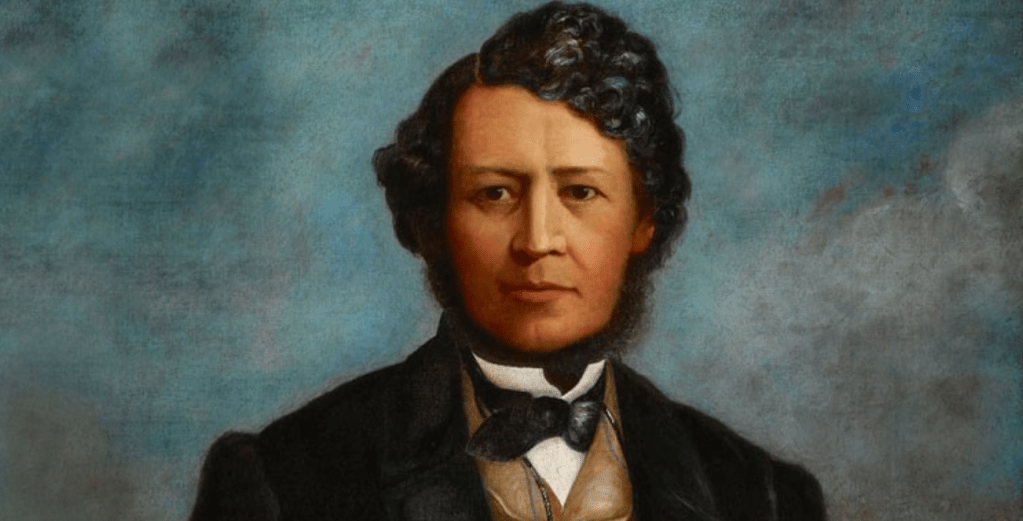
Following his return to Ireland, he became involved in the Young Ireland movement. He secured employment with The Freeman’s Journal and The Nation. Both newspapers were active promoters of Repeal of The Union and supported the campaigns of Daniel O’Connell. He delivered speeches on the necessity of repeal at venues throughout the country. At one such meeting in 1848, at Roundwood, his remarks were regarded by the police as “seditious” and he was arrested and taken before the Wicklow Assizes. He was allowed out on bail and decided to escape to Scotland to secure arms and ships for a rebellion. This venture proved unsuccessful so he returned to Ireland via Ulster. He travelled through Derry and met the Coadjutor Bishop of Derry, Bishop Maginn, a supporter of the Repeal Association. It was on this occasion that the plan was hatched for him to escape from a Donegal port. Bishop Maginn advised him to contact a priest, Fr.
McDevitt of Culdaff and he supplied him with clerical garments to disguise himself. Near Tremone Bay, a safe location five miles from Culdaff, he contacted a pilot in the village of Ballyharry who knew the movement of ships sailing to America from the port of Derry. In his disguise as a priest, McGee got on board and within a short period arrived in Philadelphia in 1848. He became well known as a poet, and the distinguished writer, Sir Samuel Ferguson, described him as the most gifted of theYoung Ireland poets.
In his new life in America, he turned against the idea of a rebellion in Ireland and condemned all revolutionary proposals. He became unpopular among the Irish community and decided to settle in Canada. Once again he became involved in the newspaper industry and took an active part in politics. He was elected to Parliament and became Minister for Agriculture in 1867. At this stage he was actively involved in the formation of the Dominion of Canada. Despite his status as a parliamentarian, the Fenians amongst the Irish community disapproved of his anti-revolutionary views on Ireland. On his journey home from Parliament in April 1868, a member of the Fenians, called Whelan, assassinated him on his doorstep in Ottawa. It was a tragic end to a promising career.
McGee is remembered at Tremone Bay, where the Tremone Historical Society have erected a monument to commemorate his escape. McGee’s descendants have visited the site as have several of the Canadian Ambasadors to Ireland. The Monument was unveiled by Canadian Ambassador to Ireland, Michael Philips. His statue stands on Parliament Hill in Ottawa.
Sean Beattie
Donegal Historical Society.
 The Legacy of the Laurentic