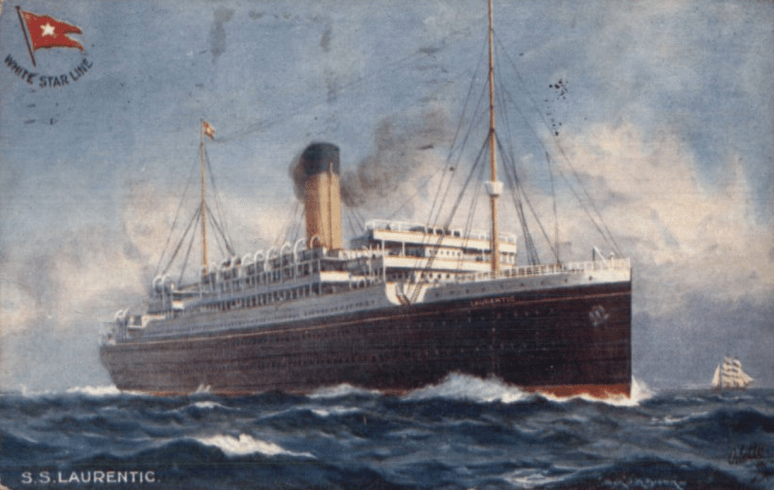
The Dominion Line steamship company operated a successful passenger service on their Liverpool to Canada route in the late 19th and early 20th centuries. In 1907 two new liners were ordered from Harland and Wolff in Belfast. During their construction they were purchased by the White Star Line, and became its first ships in the Canadian passenger trade. Originally named SS Alberta and SS Albany, afterwards they were renamed Laurentic and Megantic.
Laurentic was launched in 1908 and departed on her maiden voyage 29 April 1909, from Liverpool to Quebec City, with 1,057 passengers on board. She normally served on the Liverpool-Canada route, and also stopped in New York during the winter months. While crossing the Atlantic to New York on 22 January 1910, she was caught in a powerful storm; waves destroyed the windows of the upper deck and flooded the navigation bridge and the officers’ quarters, disabling the service command transmitters. The ship survived, and arrived safely to port. Laurentic gained notoriety later in 1910 during the capture of murderer Hawley Harvey Crippen, in which Chief Inspector Walter Dew of the Metropolitan Police used Laurentic’s speed to arrive in Canada before the fleeing suspect on SS Montrose.
Laurentic during her war service
During her regular service from Liverpool, Laurentic passed near where Titanic had sunk a few days earlier. On 21 April 1912 Captain John Mathias reported “he had kept a careful lookout while passing over the Grand Banks, and had seen neither bodies nor wreckage.”[7]
In early August 1914, before Britain declared war on Germany in what was to become World War I, Laurentic sailed from Liverpool to Canada with her accommodations full of fleeing Europeans.On 13 September, while at Montréal, she was commissioned as a troop transport for the Canadian Expeditionary Force, painted grey, and reclassified as HMS Laurentic. Still captained by John Mathias, she joined a convoy of 32 ships that transported 35,000 Canadian soldiers to Europe in October 1914. She was then rapidly converted to an armed merchant cruiser and fitted with eight 6-inch and two 6-pounder naval guns, returning to service on 31 October.
In December 1914 she left Liverpool for Sierra Leone to assist in the Kamerun Campaign, and was involved mostly with the African theatre until the following summer. In August 1915 she left for Singapore and spent the ensuing months on patrol around Singapore, Rangoon, and Hong Kong.In June 1916 she left Asia en route to Halifax, Nova Scotia by way of Cape Town, and spent the following months patrolling near Halifax. Her patrol eventually moved southward to Bermuda, and then returned directly to Halifax in October. In late November she departed for Liverpool, carrying Royal Canadian Navy officers, rated seamen, and Royal Canadian Naval Volunteer Reserves. During the voyage, Captain Mathias was accidentally struck by a steel beam while attempting to extinguish a coal fire, and died on 4 December of a fractured skull, two days before reaching Liverpool.
 The Legacy of the Laurentic